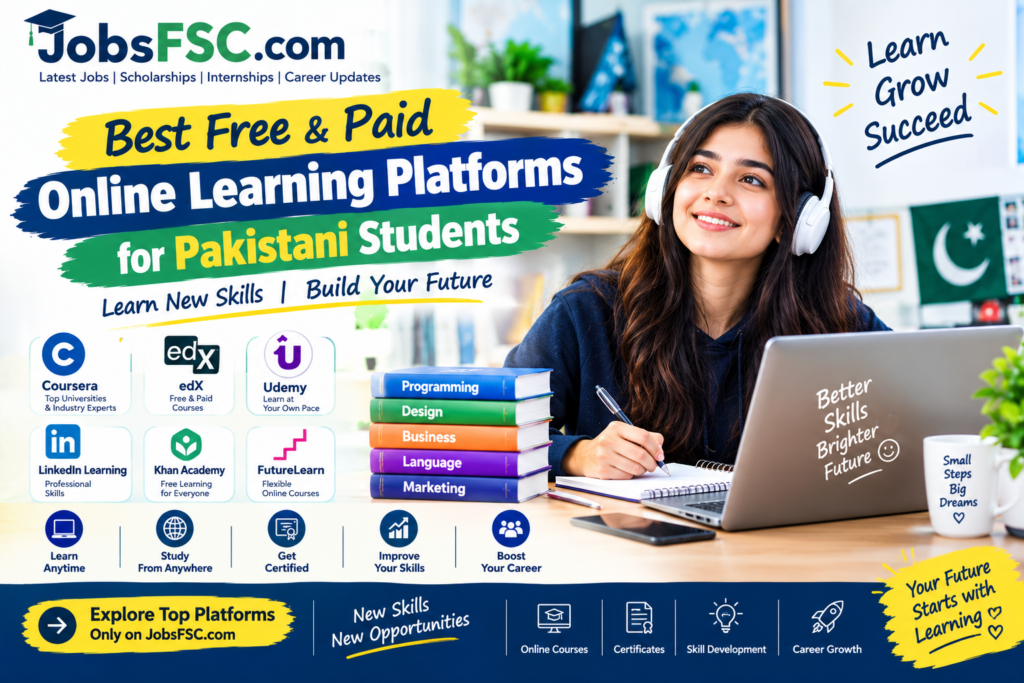

The internet has completely changed the way students learn. Today, you don’t always need to attend a physical classroom to learn a new skill. With a laptop, tablet, or even a smartphone and an internet connection, students can access thousands of online courses from institutions and instructors around the world.
For Pakistani students, online learning can be a great way to explore new subjects, improve existing skills, and prepare for future academic or professional opportunities.
Whether you want to learn programming, graphic design, digital marketing, business, languages, data science, or another subject, there are online platforms that can help you get started.
Why Online Learning Is Worth Trying
Traditional education is important, but online learning offers something different: flexibility.
You can choose what you want to learn, study at your own pace, and often access courses from anywhere.
Some major benefits include:
- Flexible study schedules
- Courses covering many different subjects
- Learning from experienced instructors
- Access to international educational content
- Opportunities to develop practical skills
- Certificates on selected courses
- Ability to learn alongside school or college
Online learning can also help students discover interests that may not be part of their regular academic curriculum.
1. Coursera
Coursera offers courses and programs from universities and organizations around the world.
Students can explore subjects such as computer science, business, data analysis, psychology, marketing, and many others.
Some courses can be audited or accessed through free options, while certificates and certain programs may require payment or financial assistance.
2. edX
edX provides online courses from universities and educational institutions.
It covers a wide range of subjects, including technology, science, business, engineering, humanities, and more.
Students who want to experience university-level learning online can explore courses based on their interests and educational goals.
3. Udemy
Udemy has a huge variety of courses created by individual instructors.
The platform covers practical skills such as:
- Web development
- Programming
- Graphic design
- Video editing
- Digital marketing
- Microsoft Office
- Photography
- Business skills
One useful feature is the wide selection of beginner-level courses, which can make it easier for students to start learning a completely new subject.
4. Khan Academy
Khan Academy is especially useful for students who want to strengthen their understanding of academic subjects.
Its learning resources cover areas such as mathematics, science, economics, computing, and other educational topics.
Students can use online lessons and practice material to revise concepts and improve their understanding.
5. LinkedIn Learning
LinkedIn Learning focuses heavily on professional and practical skills.
Students can find courses related to technology, business, communication, design, productivity, and many other areas.
It can be useful for students who want to build skills beyond their regular studies.
6. FutureLearn
FutureLearn offers online courses from universities and other organizations.
Students can explore subjects ranging from technology and business to health, language, education, and social sciences.
The platform can be useful for students who enjoy structured online learning and want to explore subjects before deciding on a larger academic direction.
What Skills Should Students Learn?
You don’t have to learn everything at once. Pick one skill that matches your interests and spend time developing it.
Technology
Programming, web development, data analysis, cybersecurity, and artificial intelligence are examples of technology-related areas students can explore.
Design
Students interested in creativity can explore graphic design, UI/UX design, illustration, photography, or video editing.
Communication
Writing, presentation skills, public speaking, and English-language skills can be useful in many academic and professional situations.
Business
Students interested in entrepreneurship can explore marketing, business fundamentals, financial literacy, project management, and customer research.
Digital Skills
Basic knowledge of productivity software, spreadsheets, presentations, online research, and digital tools can be useful regardless of your chosen field.
How to Start Learning Online
Starting is easier than many students think.
Step 1: Choose One Skill
Don’t register for ten different courses at the same time. Pick one subject that genuinely interests you.
Step 2: Set a Simple Schedule
You don’t need to study for hours every day. Create a realistic routine and try to follow it consistently.
Step 3: Practice What You Learn
Watching videos is not enough. Try to apply the information by completing exercises, projects, or practical tasks.
Step 4: Build a Small Portfolio
If you learn design, create designs. If you learn programming, build small projects. If you learn writing, create sample articles.
Practical work can help you understand whether you have actually developed the skill.
Step 5: Keep Learning
Skills improve with practice. After completing one beginner course, look for a slightly more advanced topic and continue developing your knowledge.
Don’t Collect Certificates—Build Skills
One important thing students should remember is that completing a course is only the beginning.
A certificate can show that you completed a course, but practical knowledge is even more important.
Instead of collecting dozens of certificates without practicing, focus on learning something properly and being able to demonstrate what you can do.
Final Thoughts
Online learning gives students an opportunity to explore subjects beyond their classrooms. It can help you discover new interests, develop useful skills, and become more confident with technology and independent learning.
The most important step is simply to start.
Choose one subject, find a suitable course, create a study routine, and practice what you learn. Even a small amount of consistent learning can make a difference over time.
For more useful education guides, scholarships, study-abroad information, technology updates, and student resources, keep visiting JobsFSC.com.




mkpiulfuhvloldwvyhpxgkdqtkkevq
Thanks For Apricide My Post