
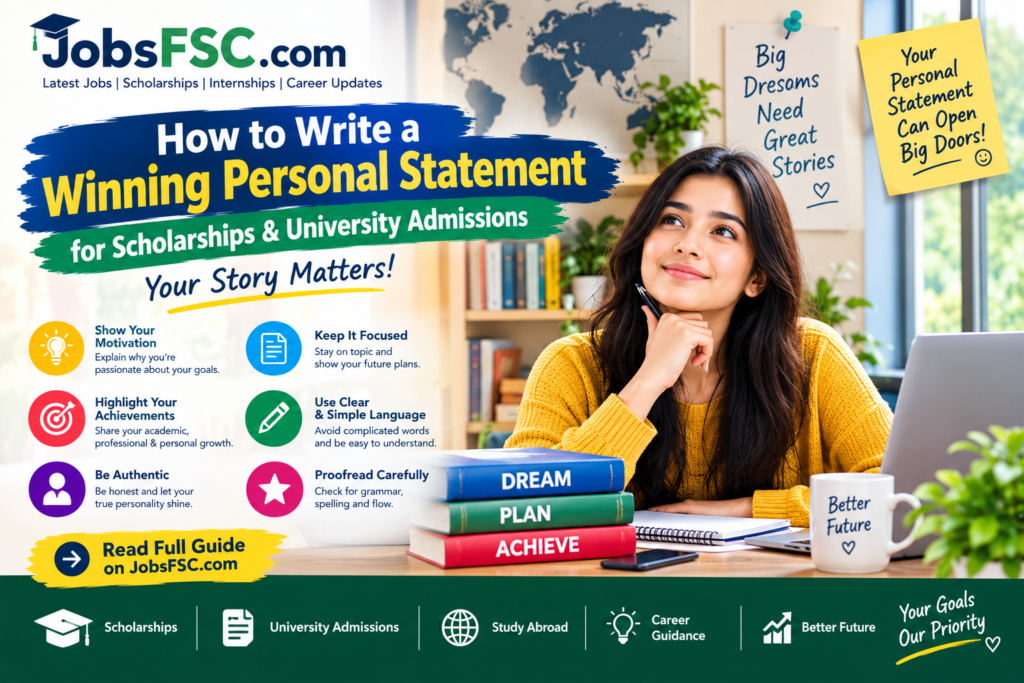

When applying for a scholarship or university admission, academic grades are not always the only thing that matters. In many applications, students are also asked to submit a personal statement.
A personal statement gives you the opportunity to explain who you are, what you want to achieve, what motivates you, and why you are a suitable candidate for the opportunity.
Writing one can feel difficult at first, especially when you are not sure what information to include. However, with the right structure and preparation, you can create a clear and convincing personal statement.
What Is a Personal Statement?
A personal statement is a short piece of writing that introduces you to an admissions or scholarship committee.
Instead of simply listing your grades and qualifications, it allows you to explain your goals, experiences, interests, achievements, and future plans.
Think of it as an opportunity to tell your story in your own words.
1. Start With a Strong Introduction
The first few lines are important because they create the reader’s first impression.
Avoid starting with very general statements that could apply to almost anyone. Instead, introduce your interest in your chosen subject or goal in a natural and personal way.
Explain what inspired you and why the field matters to you.
Your introduction does not need to be complicated. A clear and genuine beginning is often more effective than using unnecessarily difficult vocabulary.
2. Explain Your Academic Interests
Talk about the subjects you enjoy and the academic experiences that have influenced your goals.
For example, if you are interested in computer science, you could discuss how you became interested in programming, technology, problem-solving, or a particular area of computing.
Try to explain why you are interested rather than simply saying that you are interested.
3. Highlight Your Achievements
Your personal statement is a good place to discuss achievements that support your application.
These could include:
- Academic achievements
- School or college projects
- Competitions
- Leadership experiences
- Volunteering
- Community activities
- Personal projects
- Relevant courses or certifications
- Extracurricular activities
You do not need to mention every achievement you have ever received. Choose the experiences that are most relevant to your goals.
4. Show Your Motivation
One of the most important questions your personal statement should answer is:
Why do you want to pursue this opportunity?
Explain your motivation clearly.
If you are applying for a scholarship, discuss how the opportunity connects with your educational goals.
If you are applying to a university program, explain why the subject interests you and how you hope to develop your knowledge.
Specific reasons are much stronger than simply saying that you want a “better future.”
5. Talk About Your Future Goals
Universities and scholarship programs often want to understand what you hope to do in the future.
Your plans do not have to be perfectly fixed. However, you should demonstrate that you have thought about your direction.
Explain:
- What skills you want to develop
- What you hope to learn
- Which area you want to explore
- How the opportunity can help you
- What you hope to contribute in the future
A clear connection between your current interests and future goals can make your statement more meaningful.
6. Be Authentic
One of the biggest mistakes students make is trying to sound like someone else.
Your personal statement should represent you.
Use your own experiences, ideas, and achievements. Avoid copying statements from the internet or using exaggerated claims.
A simple, honest explanation of a real experience can be much more effective than a complicated paragraph that does not sound natural.
7. Use Clear Language
You do not need extremely advanced vocabulary to write a strong personal statement.
Focus on:
- Clear sentences
- Good organization
- Correct grammar
- Relevant examples
- Natural language
- A professional tone
The reader should be able to understand your message easily.
8. Proofread Before Submission
Never submit your personal statement immediately after finishing the first draft.
Read it several times and look for:
- Spelling mistakes
- Grammar errors
- Repeated ideas
- Unclear sentences
- Incorrect names or program details
- Unnecessary information
It can also be helpful to ask a teacher, mentor, or trusted person to review your writing.
A Simple Structure You Can Follow
A useful structure for a personal statement can be:
Paragraph 1 – Introduction:
Explain your interest and motivation.
Paragraph 2 – Academic Background:
Discuss your studies and relevant interests.
Paragraph 3 – Achievements & Experience:
Highlight experiences that support your application.
Paragraph 4 – Future Goals:
Explain what you want to achieve and how the opportunity fits your plans.
Paragraph 5 – Conclusion:
Finish with a confident summary of your motivation and goals.
Common Mistakes to Avoid
Students should avoid several common mistakes when preparing a personal statement.
Don’t Copy Someone Else’s Statement
Your statement should be original and based on your own experiences.
Don’t Include Irrelevant Information
Every paragraph should contribute something useful to your application.
Don’t Exaggerate
Be honest about your achievements, experiences, and abilities.
Don’t Ignore the Instructions
If an application gives a word limit or specific questions, follow them carefully.
Don’t Submit Without Proofreading
Even a strong application can look less professional if it contains avoidable spelling or grammar mistakes.
Final Thoughts
A personal statement is more than just another application requirement. It is an opportunity to show your personality, motivation, experiences, and future ambitions.
Take your time, organize your ideas, use real examples, and make sure your final statement sounds like you.
Remember that there is no single perfect personal statement. The strongest statements are usually clear, relevant, honest, and connected to the applicant’s genuine goals.
For more useful guides about scholarships, university admissions, education, study abroad, technology, and student opportunities, keep visiting JobsFSC.com.





wfuisgxmzurtwvikensfxiptrvmyle
Thanks For Apricide My Post